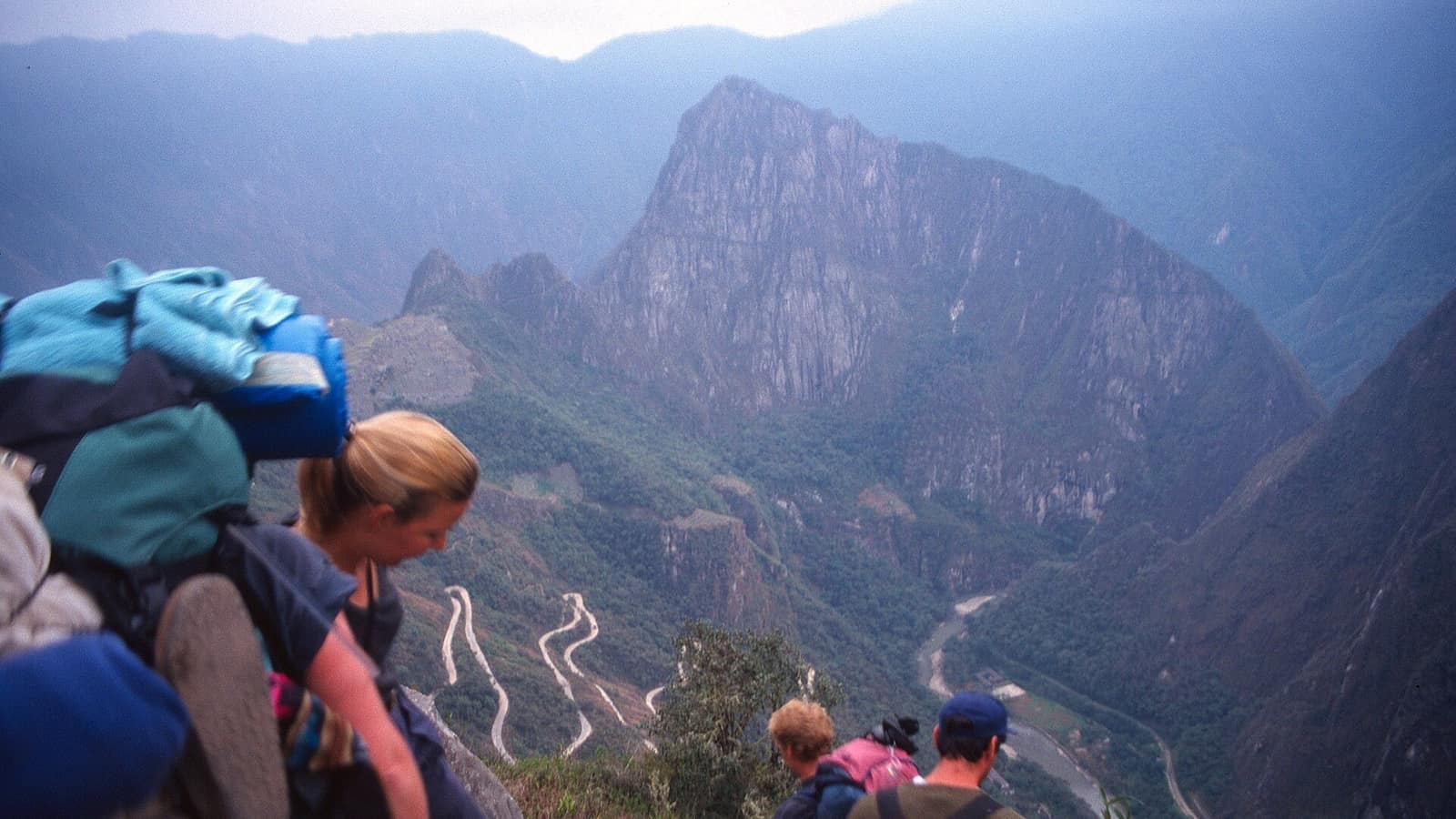

Cusco region, Peru
The Inca Trail to Machu Picchu: Permits and the Four-Day Route
Four days on a paved Inka road over two passes, ending at the Sun Gate. Permit-capped, sold out months ahead, and closed every February.
- Length
- ≈43 km
- High pass
- 4,215 m
- Closed
- February
The Inca trail is a 43-kilometre section of the Inka road network running from the Urubamba valley over two passes to Machu Picchu, and it is the most regulated trek in South America. Permits are capped daily, issued through licensed operators, and gone months in advance for the dry season.
What you are walking is not a path worn by hikers. Much of it is original paved road with cut stone steps, drainage and retaining walls, built to carry runners and llama trains rather than tourists, and passing through half a dozen Inka sites that most people see from nowhere else.
The four days
Day one is the gentle one: from Km 82 along the Urubamba, past Llactapata, to a first camp around 3,000 m.
Day two is the reason the trek has a reputation. A long climb to Warmiwañusca, Dead Woman’s Pass at about 4,215 m, then a steep stone descent into the next valley. Most of the trek’s difficulty is in this one day.
Day three is the best of it: a second pass, the sites at Runkurakay, Sayacmarca and Phuyupatamarca, and a long descent through cloud forest to Wiñay Wayna.
Day four starts before dawn for the walk to Inti Punku, the Sun Gate, and the first view down onto Machu Picchu. Groups reach the site itself in mid-morning.
Permits, and what they mean in practice
The daily quota covers trekkers, guides and porters together, which is why the effective number of visitors is far lower than the headline figure. Permits are non-transferable and tied to a passport; changing names after booking is not possible.
Permits for the whole year are released the preceding October (the Ministerio de Cultura de Cusco issues them); book six to nine months ahead for June to August. February is closed entirely. The shoulder months of April and October are the best compromise between weather and availability.
Porters, weight limits and what the rules are for
Every group on the classic route walks with porters, and the conditions they work under are regulated because they were once notoriously bad. Peruvian law caps the load a trail porter may carry at 20 kg for men and 15 kg for women, under Ley 31614 of 2022, weigh-ins are carried out at checkpoints along the route, and operators are required to provide their crews with equipment and insurance.
Enforcement is real but uneven, and the price of a trek is the most reliable indicator of whether it is happening. An operator selling the four days well below the market rate is saving the money somewhere, and the crew is where it is usually saved. Asking what the porters are paid, what they sleep in and what they carry is a fair question that a good operator answers without hesitation.
Trekkers can hire an additional personal porter for their own duffel, usually with a limit around 7 kg. Anyone in doubt about the second day should do this rather than economise on it.
Altitude, and preparing for the second day
The trek starts at about 2,700 m and tops out at roughly 4,215 m, and every serious problem on the route is an altitude problem rather than a fitness one. Two nights in the Sacred Valley before starting, ideally lower than Cusco, is what most operators recommend and what most people skip.
The practical preparation for day two is simple and boring: arrive acclimatised, start slowly, drink more than feels necessary, and accept that the pass takes as long as it takes. Groups are timed against camp arrivals rather than against each other, and there is no advantage in reaching Warmiwañusca first.
The alternatives, honestly compared
- Salkantay. Five days, higher and emptier, crossing a pass around 4,600 m under the mountain of the same name. No permit cap.
- Lares. Shorter, lower, through villages that still weave and herd, and the one to pick if the walking is not the point.
- Choquequirao. Four to five days there and back to a site half-excavated and largely empty, with a brutal canyon descent and re-ascent at either end.
None of them arrive at the Sun Gate, and that is the only thing the classic route offers that the others cannot. Everything else, meaning mountains, cloud forest, ruins and altitude, they have in equal or greater measure.
The Peru section covers the stonework these routes run through, including Inca architecture and the fountains at the end of the walk.
Frequently Asked Questions
How far in advance do you need a permit?
Five to six months for the high season of May to September, and it is not unusual for the best months to sell out the day the year's quota opens. Permits are issued to licensed operators, not to individuals, so you book a trek rather than a permit.
Can you walk the Inca trail without a guide?
No. The route has been guided-only since 2001, and independent walking is not permitted at any point.
How hard is it?
The distance is modest and the altitude is not. Day two climbs to Warmiwañusca at about 4,215 m, which is the crux for most people, and the descents on days two and three are long and steep on stone steps.
When is the trail closed?
Every February, for maintenance and because it is the wettest month. The rest of the year it runs, with June to August the busiest and driest.
What are the alternatives if permits are gone?
Salkantay is the usual answer: higher, wilder, five days, no permit cap. Lares is shorter and passes working weaving villages. Choquequirao is the hardest and ends at a site most people have never heard of, which is its argument.
Do the alternatives reach the Sun Gate?
No. Only the classic route arrives at Machu Picchu through Inti Punku on foot; the others descend to Aguas Calientes and enter the site the normal way the following morning.
How much do you carry?
Your day pack. Porters carry camp and duffels within a weight limit set by law after a long history of abuse, and that limit is checked at control points.
Is altitude sickness a real risk?
Yes, and the trailhead itself is at about 2,700 m with the first camp higher. Two nights minimum in Cusco or lower in the Sacred Valley before starting is the standard precaution.