
Chimaltenango, Guatemala
Acatenango Volcano: the Overnight Hike and the View to Fuego
An overnight climb to nearly 4,000 m above Antigua, camped on a ridge facing Volcán de Fuego, which erupts through the night in full view.
- Summit
- 3,976 m
- Camp
- ≈3,600 m
- Trip
- 2 days
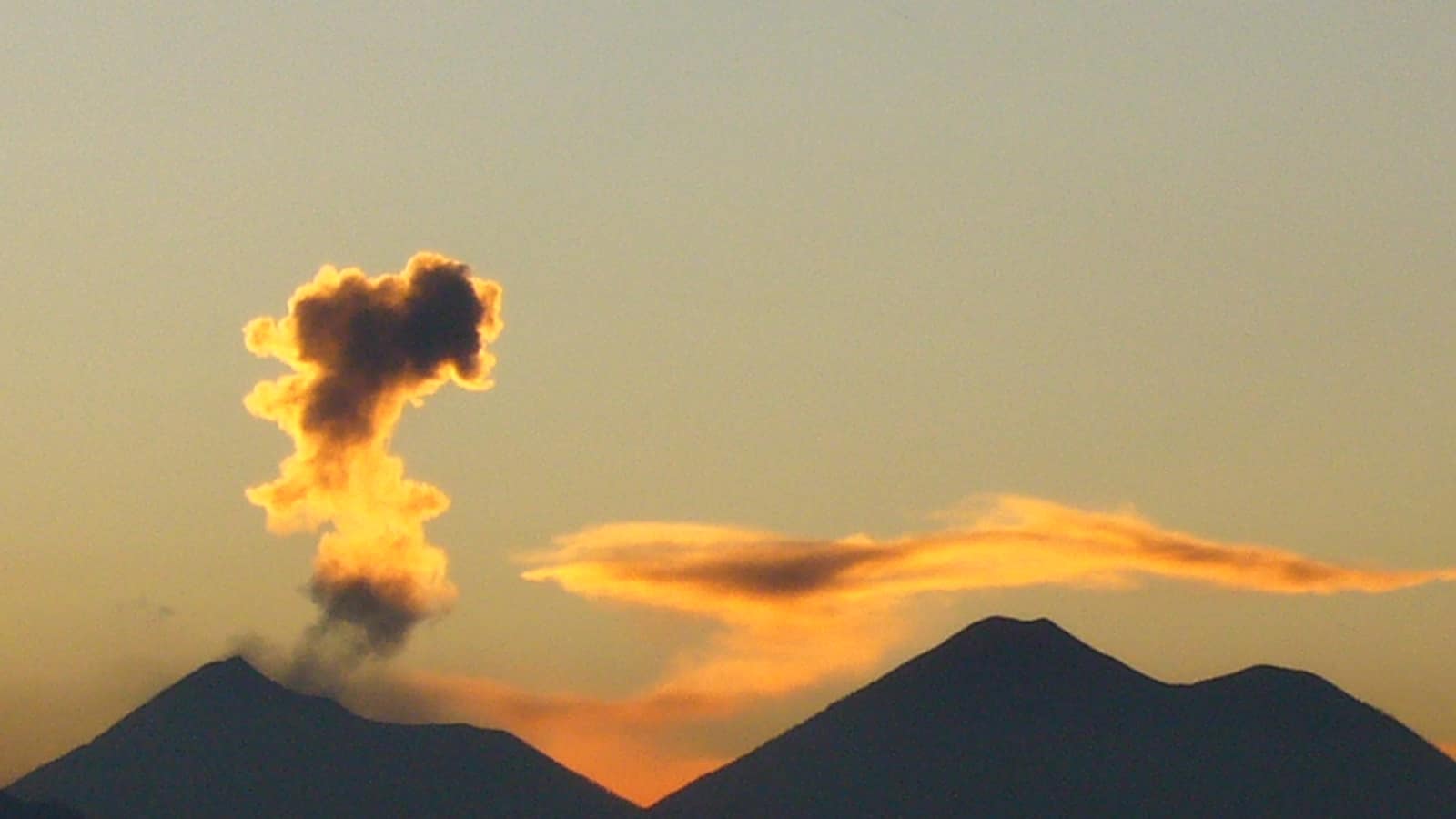
Acatenango volcano stands at 3,976 m, the third-highest peak in Guatemala, and the reason people climb it is the mountain next door. Volcán de Fuego is in near-continuous eruption a few kilometres across the saddle, and the standard Acatenango trip camps on a ridge facing it.
The result is a night spent watching a volcano throw material into the air every fifteen or twenty minutes, from a camp high enough to be looking across at it rather than up.
What the two days involve
Transport from Antigua to the trailhead above La Soledad takes about ninety minutes. From there the climb is five to six hours through farmland, then cloud forest, then alpine scrub, on ground that is loose volcanic soil most of the way: two steps up, one back, for long stretches.
Camp sits around 3,600 m. It is cold; on a clear night it drops below freezing and the wind on the ridge does the rest. Groups eat, watch Fuego, and sleep badly.
The summit push leaves before dawn: another 400 vertical metres of loose ash, an hour or so, to arrive at the crater rim for sunrise over the chain of Agua, Fuego and Pacaya, and on a clear morning the ranges towards Mexico. Then everything back down, which takes about three hours and is harder on the knees than the ascent was on the lungs.
The Fuego add-on
Several operators offer a walk from the Acatenango camp out onto the ridge below Fuego’s cone, much closer to the activity. It is spectacular, it is more exposed, and access is closed by the national authority when Fuego’s activity escalates, as it has done repeatedly, including the eruption of June 2018, which killed people on the volcano’s southern flank.
Closures are decided at short notice. An operator promising the Fuego ridge months ahead is promising something they cannot know.
Altitude, and who finds this hard
Nothing on Acatenango is technical, and the two things that turn it back are altitude and cold. Camp sits at around 3,600 m and the summit is just under 4,000 m, which is high enough for a headache and a bad night’s sleep to be normal rather than a warning sign. Anyone arriving in Antigua from sea level two days earlier will feel it more than their fitness predicts, and the usual answer is to spend a few days in the highlands first, which most itineraries do anyway.
The cold is the part that is consistently underestimated. Antigua at midday is warm, the ridge at two in the morning is not, and the wind runs across the saddle all night. A hat, gloves and a warm layer that is not the one you climbed in are what make the difference between watching Fuego for hours and lying in a tent waiting for daylight.
Fitness, packs and porters
Five to six hours of continuous ascent on loose ground with a pack is the honest description. The gradient is steady rather than steep and there is no scrambling, so it rewards patience more than strength, but carrying a full pack including water for two days is what most people find hardest.
Porters are available through most operators and are worth the money for anyone unsure about the climb. Water is the heaviest single item and there is none on the mountain, so four litres a person is the working figure. Rain gear matters in every season: the cloud forest band on the way up generates its own weather regardless of what the forecast says about the valley.
Access, and who closes the mountain
Access is charged at the La Soledad trailhead and a guide is required. The amount is not worth taking from any single page, including this one: operators quote different trailhead fees, and whether the fee sits inside the tour price or is collected separately on the morning varies between them. The question when booking is not what the fee is but whether it is included, because that is the part that produces an argument at the gate.
The closure decision has a chain behind it, and it is worth knowing the names. INSIVUMEH publishes a daily volcanological bulletin on Fuego and issues special bulletins when activity escalates. CONRED, the national disaster-reduction authority, is the body that restricts access on the strength of them. That chain operates on the day, which is precisely why an operator cannot promise the Fuego ridge months ahead.
The eruption of 3 June 2018 is why it works this way now. Pyroclastic flows destroyed communities on Fuego’s southern flank, and the confirmed-dead and still-missing counts published in the weeks afterwards differ substantially from each other. That gap is not sloppy record-keeping; it is the clearest available statement of how fast the flows arrived.
Choosing an operator
The gap between operators is unusually wide here: tent quality, sleeping-bag rating, group size, food, and whether porters are offered at all. This is a trip where the cheapest option is frequently the reason people describe the night as the worst of their lives.
Ask specifically about the sleeping bag rating and the tent, and take your own warm layers regardless of the answer.
The rest of the volcano line is in the Guatemala section, and most people climb from a base in Antigua.
Frequently Asked Questions
How hard is Acatenango?
Hard. Roughly 1,200 m of ascent to the camp in five to six hours on loose volcanic soil, carrying your own kit unless you hire a porter, finishing at a camp around 3,600 m. Fitness matters and altitude matters more.
How cold does it get?
Below freezing at the camp on a clear night, with wind. Operators supply tents and sleeping bags of varying quality; taking your own warm layers is the difference between a memorable night and a miserable one.
Do you see Fuego erupting?
Usually. Fuego is in near-constant low-level activity and the camp faces it across a saddle. Cloud is the variable, not the volcano.
Can you climb Fuego itself?
There is a separate route onto the ridge below Fuego's cone, which some operators run as an add-on from the Acatenango camp. It is closer, more exposed, and closed by the authorities when activity escalates.
Do you summit Acatenango?
Most groups leave camp before dawn for the last 400 m to the summit, which is the coldest and steepest part of the trip and where the view opens across the whole volcanic chain.
Can you hire a porter?
Yes, arranged through the operator or at the trailhead, and worth it for anyone who is not certain about the ascent. The porters are from the villages on the mountain's lower slopes.
What do you need to bring?
Warm layers, gloves, a hat, a headtorch, four litres of water and shoes with grip. Everything else is usually provided; check exactly what before booking, because the range between operators is wide.
Is it suitable as a first hike at altitude?
Not really. Doing Pacaya first, and spending a couple of days in Antigua at 1,530 m, makes it considerably more pleasant.