
Sacatepéquez, Guatemala
Antigua Guatemala: Things to Do, the Ruins and Colonial Architecture
Colonial capital from 1543 until the 1773 earthquakes moved the government away, and the abandonment is exactly why the townscape survives: ruined convents left standing where a working capital would have cleared them.
- Founded
- 1543
- Elevation
- 1,530 m
- From the airport
- ≈1 h
Things to do in Antigua Guatemala start with a fact about the town’s failure: it stopped being the capital in 1776, and almost nothing has been built over since. What you walk through is a mid-eighteenth-century colonial capital with the roofs off: a townscape that survives because the money left. The grid, the convents, the arches and the ruins are all where they were, and Volcán de Agua closes the end of most streets.
Antigua Guatemala sits at about 1,530 m in the Panchoy valley, an hour from the airport at Guatemala City, and it is small: you can cross the centre on foot in twenty minutes, cobbles permitting. A compact grid, three volcanoes on the skyline and more surviving colonial architecture than anywhere else in Central America: that combination is the whole case for the place.
Things to do in Antigua Guatemala: the short list
What to do in Antigua Guatemala, in the order most people find works:
- Parque Central first, for the Palacio de los Capitanes Generales along one side and the cathedral front along another.
- The Catedral de Santiago ruins, entered from behind the working church. Collapsed domes, open sky, and the clearest single lesson in what 1773 did.
- Las Capuchinas, the most architecturally interesting of the convents, with a circular tower of cells around a courtyard.
- La Merced, the yellow baroque church whose facade is the most ornate in town and one of the few that came through the earthquakes intact enough to still be in use.
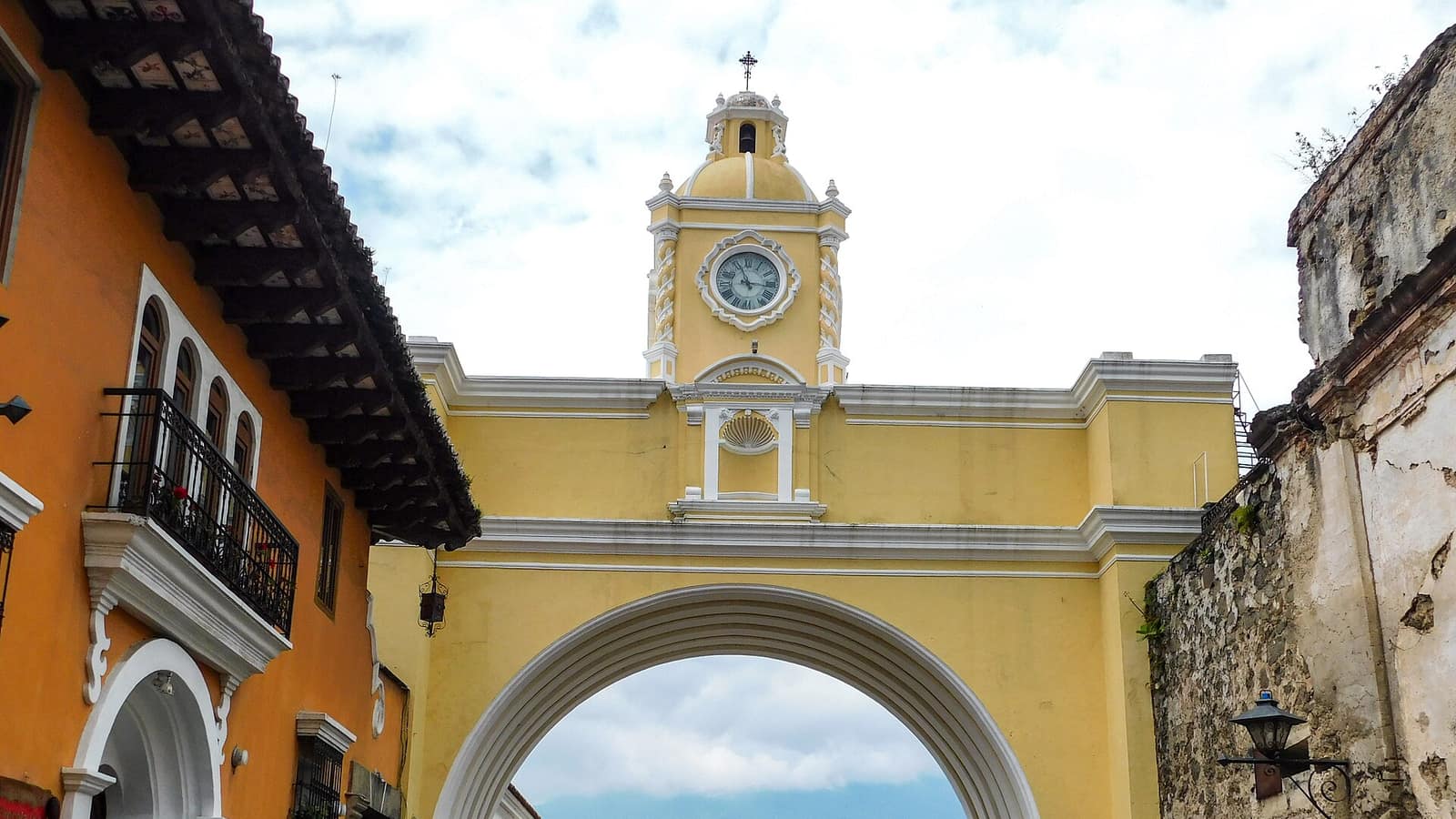
- The Santa Catalina Arch on 5a Avenida Norte, with Agua behind it.
- The market, west of the centre, which is where the town stops performing for anybody.
- Cerro de la Cruz, twenty minutes uphill, for the view down the grid to the volcano.
Two days covers this comfortably, and it is the itinerary most people should aim at. One day covers the same list at a pace that turns the ruins into a series of courtyards.
If you only read one paragraph about what to do in Antigua Guatemala: walk the grid in the morning, pick two ruins rather than six, and be somewhere with a rooftop when the light goes.
The ruins: what the 1773 earthquakes left standing
The Santa Marta earthquakes of 1773 were not the first to hit the city and were the ones that ended the argument. The crown ordered the capital moved; it went in 1776 to what is now Guatemala City, and the religious orders largely went with it.
That is why the ruins here read differently from ruins elsewhere. These buildings were not destroyed and cleared. They were abandoned mid-repair, and the town grew back around them at a smaller scale. Santo Domingo was one of the richest monasteries in the Americas and is now partly a hotel, partly an excavated complex you can walk through. San Francisco holds the tomb of Hermano Pedro de San José de Betancur, canonised in 2002, and is a working pilgrimage site rather than a monument.
Not every ruin justifies its entrance fee. If you are picking, take Las Capuchinas and the cathedral; the rest are best seen from the street unless you already like the subject.
Colonial architecture, and how to read a facade
Antiguan colonial architecture has a name, earthquake baroque, and a logic. Walls are thick and low, towers are squat, ornament is heavy stucco rather than carved stone, and buttresses appear where a European church of the same period would have had height. The style is what you get when builders keep rebuilding after seismic damage and design for the next one.
Two things to look for. First, the difference between a facade that survived and one that was rebuilt: original stucco is deeper-cut and less regular than twentieth-century restoration. Second, the water: fountains everywhere, because the city was supplied by gravity from the hills and the fountain was the utility, not the ornament. The Fuente de las Sirenas in the plaza is the best known and one of many.
The colonial architecture of the town is protected by a conservation regime that reaches down to paint colours and signage, which is why the streets look consistent and why every hotel entrance is a wooden door in a plain wall.
A two-day itinerary that is not a forced march
Day one, the centre. Parque Central, the cathedral ruins, the Palacio de los Capitanes, lunch, then the market and La Merced. Finish at the arch when the light goes orange, then a rooftop for the Fuego view after dark.
Day two, the edges. Las Capuchinas early, Santo Domingo mid-morning, San Francisco after lunch, Cerro de la Cruz in the afternoon. If you would rather swap one of these for a coffee farm on the town’s outskirts, that is the standard third option and it is genuinely good.
An itinerary with a volcano in it needs a third day. Pacaya is a half-day trip and the one where you walk on recent lava; Acatenango is an overnight, high, cold and the reason most people come back with a photograph of Fuego erupting below them.
Getting there: Guatemala City to Antigua
The Guatemala City to Antigua run is about 45 km and the single most-asked logistics question about the town. Shuttles leave from La Aurora airport and from hotels in the capital throughout the day; expect an hour, and more in the morning and evening peaks. Private taxis cost several times more and save little.
Guatemala City to Antigua is also the last leg of most arrivals, since the airport is on the capital’s southern edge and the shuttle desks are inside the terminal.
Coming from the other direction, whether Lake Atitlán, Panajachel or Chichicastenango on a market day, tourist shuttles run daily and take between two and a half and four hours depending on the road. Antigua is the hub the rest of the highlands is reached from, which is the practical reason most itineraries start here rather than in the capital. The wider Guatemala section has the other subjects in the region.
Is Antigua Guatemala safe, and what does it actually cost?
Is Antigua Guatemala safe is a fair question to ask about a country with Guatemala’s reputation, and the honest answer is that this town is an easier place to be than most. People ask is Antigua Guatemala safe far more often than the answer warrants, largely because they are really asking about the country. There is a dedicated tourist police presence, the centre is small and busy into the evening, and the crimes visitors actually encounter are opportunistic rather than violent. Watch bags in the market, take a taxi after dark on the outskirts, and treat the cobbles with more respect than the crime rate.
Things to do in Antigua Guatemala after dark are limited and pleasant: dinner, a rooftop, and an occasional concert in a restored convent courtyard.
On cost: Antigua is the most expensive town in Guatemala and remains inexpensive by most visitors’ standards. Where the premium bites is centre-of-town hotels in high season and Semana Santa, when rooms are booked months in advance and rates roughly double.
Frequently Asked Questions
How many days do you need in Antigua Guatemala?
Two full days covers the town itself without hurrying: one for the central ruins and the market, one for the outlying convents and a viewpoint. Add a third if you want a volcano: Pacaya takes half a day, Acatenango takes two.
How do you get from Guatemala City to Antigua?
It is about 45 km. A shuttle or a taxi from La Aurora airport takes roughly an hour outside rush hour and appreciably longer inside it. Shuttles run all day and are the normal choice; chicken buses are cheaper, slower and involve a change at Chimaltenango.
Is Antigua Guatemala safe?
By Guatemalan standards it is one of the easier places to be, with a visible tourist-police presence and a small, walkable centre. The usual urban precautions apply after dark, the cobbles are genuinely dangerous in the wet, and the Cerro de la Cruz viewpoint is best done in daylight or with the police escort that has long been offered from the plaza.
Which ruins are worth paying to enter?
Las Capuchinas for the circular convent tower, Santo Domingo for the scale, and the Catedral de Santiago behind the working church for the collapsed vaults. San Francisco is free to enter and busy with pilgrims at Hermano Pedro's tomb, which makes it a different kind of visit.
What is the Santa Catalina Arch?
A yellow arch across 5a Avenida Norte, built so that cloistered nuns could cross the street unseen between two parts of their convent. It is the most photographed thing in town, mostly because Volcán de Agua lines up behind it.
Can you see the volcanoes erupting from Antigua?
Volcán de Fuego is in near-constant low-level activity and is regularly visible from rooftops in town, especially at night. Agua and Acatenango are quiet. Fuego's activity varies and access to the Acatenango ridge opposite it is closed by the authorities when it escalates.
What is Semana Santa like in Antigua?
The largest Holy Week observance in Latin America: processions carrying enormous andas over alfombras, the carpets of dyed sawdust, flowers and pine needles laid on the street and destroyed as the procession passes. Accommodation is booked out months ahead and prices roughly double.
When is the best time to visit?
November to April is the dry season and the reliable window. May to October brings afternoon rain, usually predictable enough to plan around, and greener surroundings. Semana Santa is spectacular and the worst time to come if you want a quiet town.
Why was the capital moved away?
The Santa Marta earthquakes of 1773 damaged the city badly enough that the crown ordered the capital relocated. It moved in 1776 to the valley where Guatemala City now stands, and Antigua was left with buildings nobody was going to rebuild.
Is Antigua Guatemala expensive?
It is the most expensive town in the country and still cheap by North American or European standards. The gap is widest on restaurants and hotels in the centre and narrowest on transport and market food.
What is there to do in the evening?
Rooftop bars for the Fuego view, a dense concentration of restaurants for a town this size, and concerts in the courtyards of a few restored convents. It is not a late city: much of the centre is quiet by midnight.
Do you need a guide for the town?
Not to walk it. A guide pays for itself inside the ruins, where the difference between a pile of masonry and a legible building is entirely a matter of having somebody explain what you are standing in.