
Galápagos, Ecuador
Galápagos Islands Animals: What Lives There, and on Which Island
The animals are the reason to go and they are not evenly distributed: most species are tied to particular islands, and several are tied to particular months. What lives there, where it actually is, and what a visit is allowed to do.
- Waved albatross
- Apr–Dec
- Islands visited
- ~12
- Guide
- compulsory
- Distance
- ≈900 km
The Galápagos are about 900 km off the Ecuadorian coast, and the animals there are the whole reason the archipelago is famous. What most planning gets wrong is treating them as a single list to be ticked off. They are not evenly distributed. Several of the species people specifically travel for live on one or two islands and nowhere else, and a few are tied to particular months, so which animals a trip sees is decided by the route and the season before anyone gets on a boat.
The reptiles: giant tortoises and the two iguanas
The giant tortoise is the animal the islands are named for, and there are still distinct populations on different islands, differing most obviously in the shape of the shell: dome-backed on the wetter, higher islands where food is underfoot, saddle-backed on the drier ones where the animal has to reach up for it. They are seen in the wild in the humid highlands of Santa Cruz and on Isabela, and in breeding centres on several islands. In the dry season they move uphill for grass and standing water, which is where the reserves are.
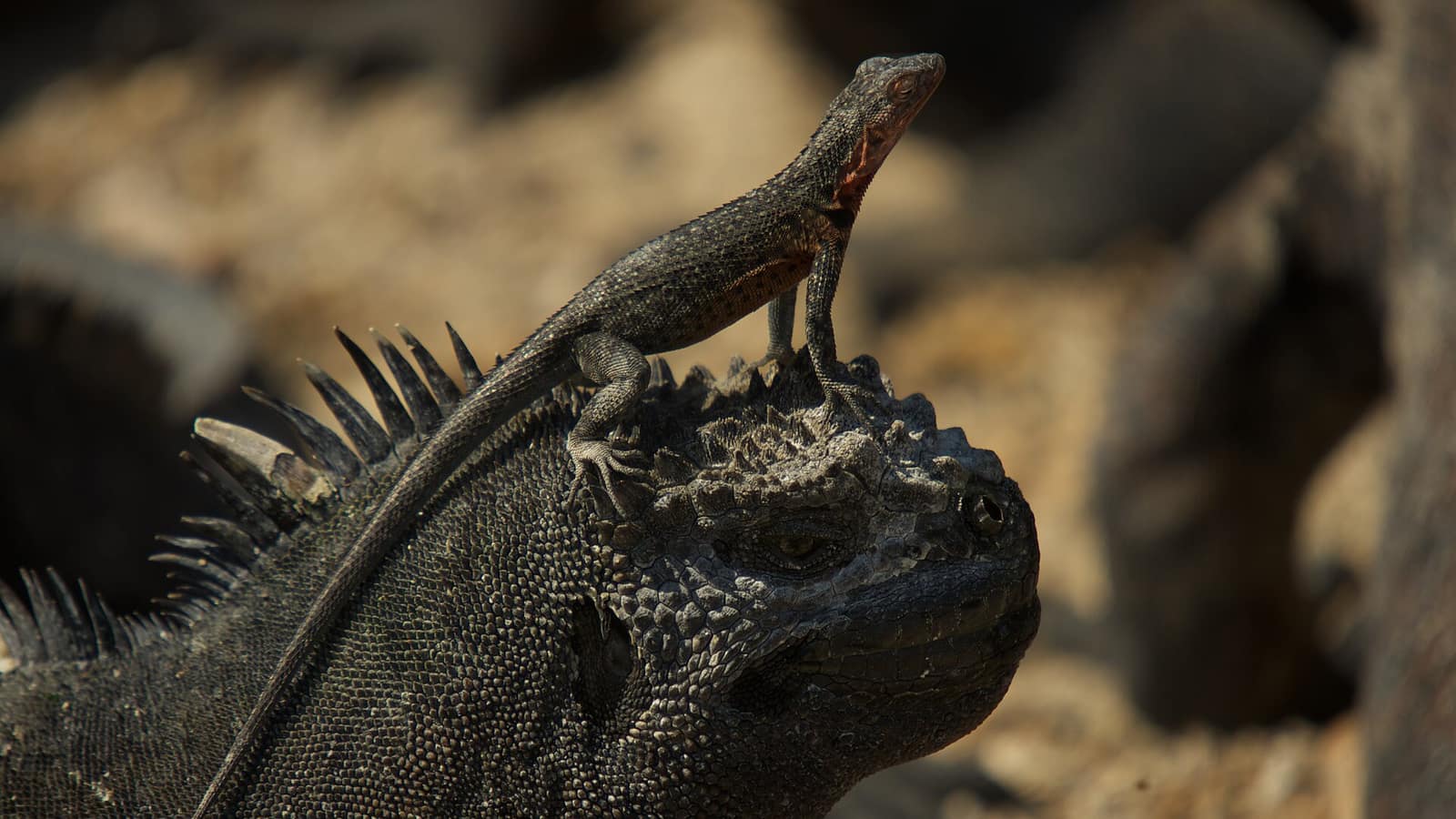
The marine iguana is the only lizard in the world that feeds in the sea. It grazes algae off submerged rock, hauls out onto black lava to warm up again, and sneezes out the salt through a gland above its eyes. The white crust on the head is that salt. It is on every main island, and the largest are on Española, where the breeding males also turn red and green.
The land iguana is yellower, blunter and lives inland on the drier islands: Santa Fé, South Plaza, parts of Isabela and Santa Cruz. Where its range overlaps the marine iguana’s on South Plaza the two have occasionally hybridised, which is one of the few places in the world that happens between genera.
The birds: three boobies, a cormorant that cannot fly, and the finches
The blue-footed booby is the one everyone knows, and the feet really are used: the male lifts them deliberately in the courtship display. It is widespread and easy to see. The Nazca booby is larger and white with a dark mask, and nests on cliff edges, notably on Española and Genovesa. The red-footed booby is the one most trips miss: it is the only one of the three that perches in trees, and the accessible colony is on Genovesa in the far north-east, which not every itinerary reaches.
The flightless cormorant is the strangest bird on the islands — a cormorant that lost the use of its wings because there was nothing to escape from and better fishing in the cold water to the west. It lives only on Isabela and Fernandina. The Galápagos penguin, the only penguin that breeds north of the equator, is in the same place for the same reason: the Cromwell upwelling brings cold, fish-rich water up the western side of the archipelago.
The waved albatross is the clearest example of the season deciding the trip. Almost the entire world population breeds on Española, and it is there roughly from April to December. Outside those months the island has no albatross at all.
Darwin’s finches are less spectacular than the reputation suggests: small, brown, and separated mainly by the depth and shape of the beak. They are also the reason the islands matter to biology, and once the beak differences are pointed out they are visible.
The mammals, and the sea
The Galápagos sea lion is the animal a visitor is most likely to be close to, because it lies on the same beaches and landing docks people use. The bulls are territorial and are best left a wide margin; the young are not, and will follow a snorkeller. The Galápagos fur seal is smaller, has denser fur and prefers shaded rocky ledges, so it is seen less.
In the water the list lengthens: white-tipped reef sharks, hammerheads in the north around Darwin and Wolf, rays, green turtles, and dolphins between the islands.
What the season changes
The warm season, roughly December to May, has calmer, warmer water and better visibility, and is when the marine iguanas are in breeding colour and the land birds nest. The cool season, roughly June to November, brings the Humboldt current, rougher water and more nutrients. That is better for the penguins, the cormorant and the larger marine life, and it is when the albatross is on Española. Neither is a bad season; they show different things.
What a visit is allowed to do
Almost all of the archipelago is national park, and the visitor sites within it are entered with a licensed naturalist guide, on marked trails, in controlled group sizes. There is a minimum approach distance of about two metres from any animal, and it is enforced — not because the animals are nervous, but because they are not: they will not move away from a person, so the distance has to be kept from the other side. Feeding and touching are prohibited, as is taking anything organic on or off an island. The park entrance fee is paid on arrival and the transit control card is bought at the mainland airport.
The inhabited parts of Santa Cruz, San Cristóbal, Isabela and Floreana can be walked without a guide, and there is more to see from them than a day-trip itinerary suggests: the Santa Cruz highlands, the tortoise reserves, and the shoreline near the towns.
For how the Galápagos compares on cost and time against the rest of the region, see the outline of the neighbouring countries.
Frequently Asked Questions
What animals live on the Galápagos Islands?
The animals people come for are the giant tortoises, the marine iguana, the three species of booby, the Galápagos sea lion, the flightless cormorant, the Galápagos penguin, the waved albatross and Darwin's finches. Most are found nowhere else. The important thing for planning is that they are not spread evenly: several are effectively single-island animals.
Which island has the most animals to see?
There is no single answer, which is why itineraries move. Española has the waved albatross and the largest marine iguanas; Isabela and Fernandina have the flightless cormorant and the penguins; Santa Cruz and Isabela have the giant tortoises in the wild; Genovesa has the red-footed booby. A one-island trip sees a fraction of the list.
Do you need a guide in the Galápagos?
Yes, in the national park, which is most of the archipelago. Visitor sites are entered with a licensed naturalist guide and group sizes and routes are controlled. The inhabited parts of Santa Cruz, San Cristóbal, Isabela and Floreana can be walked without one.
What do the animals eat, and why does that matter to a visitor?
It matters because it decides where they are. The marine iguana grazes algae off submerged rock, so it is on the shoreline; the flightless cormorant and the penguin feed in the cold Cromwell upwelling on the western side, which is why they are on Isabela and Fernandina and not in the east; the giant tortoises follow the grass and the standing water up into the humid highlands in the dry season.
Are the animals really unafraid of people?
Largely, yes, because nothing on the islands hunted them before people arrived. That is also why the two-metre rule exists and is enforced: the animals will not move away from you, so the distance has to come from your side.