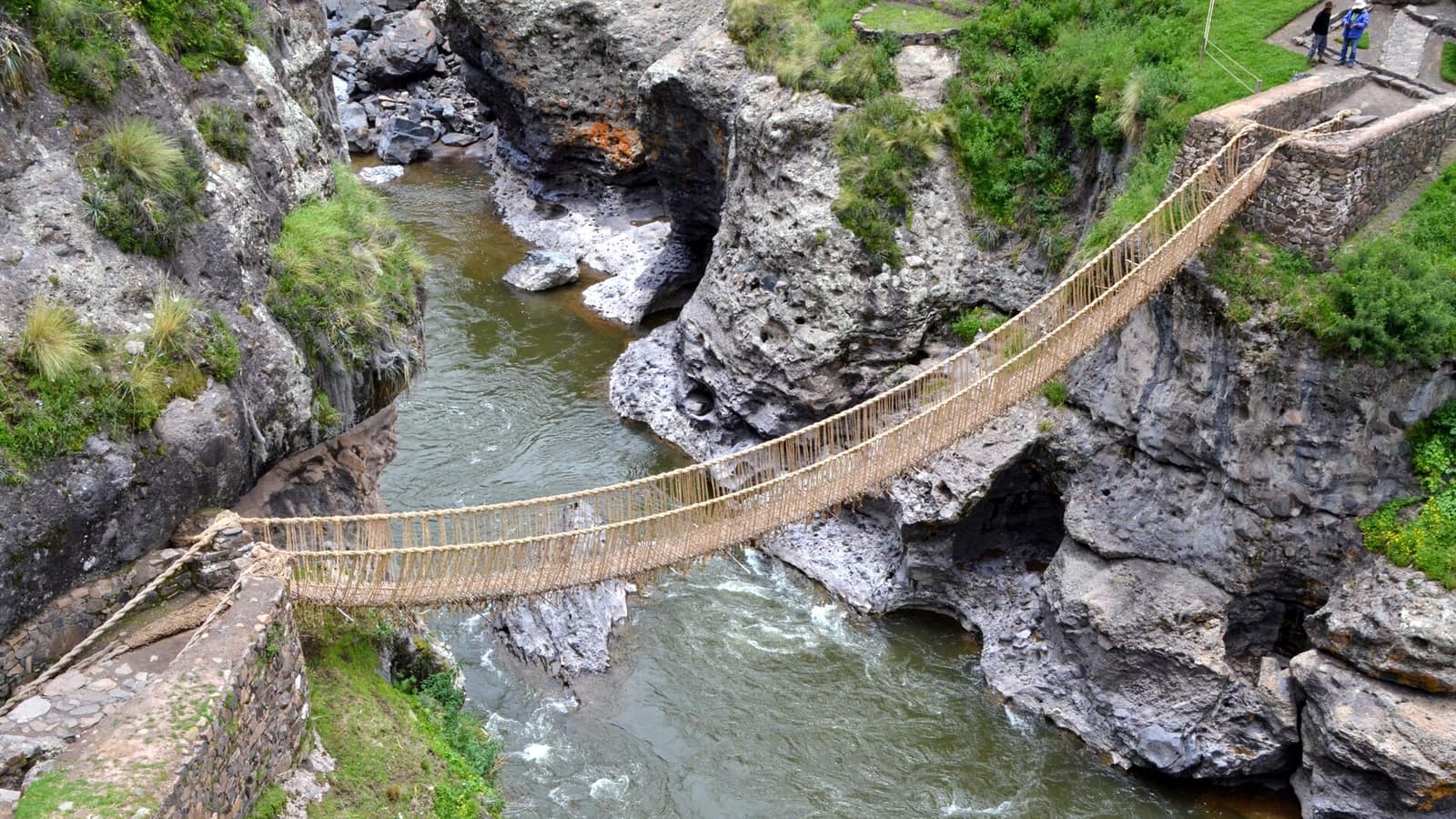

Canas, Cusco region, Peru
The Q'eswachaka Bridge: the Last Inka Rope Bridge, Rebuilt Yearly
The last surviving Inka suspension bridge, cut down and rebuilt from twisted grass every June by the four communities that have always maintained it.
- Span
- ≈28 m
- Rebuilt
- every June
- Material
- q'oya grass
The Q’eswachaka bridge crosses the Apurímac gorge in the Cusco region on cables made of twisted grass, and it is the last Inka suspension bridge still in use. Every June it is cut down and built again from nothing over three days.
The Inka road system crossed hundreds of gorges this way. Spanish chroniclers described the bridges with a mixture of astonishment and unease, and colonial administrations kept several of them running for centuries because there was no better option. Q’eswachaka is the one that never stopped.
How the rebuild works
Households in four communities (Huinchiri, Chaupibanda, Choccayhua and Ccollana Quehue) spend the preceding weeks collecting q’oya grass, soaking and beating it, and twisting it into thin cord. Each community brings a fixed share to the gorge.
On the first day the cord is braided into six thick cables, each roughly the thickness of a thigh, worked on the ground along the riverbank. The old bridge is then cut and dropped into the water.
On the second day the new cables are hauled across and anchored to the stone abutments on each side: four for the deck, two for the handrails. Weavers work towards each other from opposite banks, sitting on the cables as they go, closing the gap in the middle.
On the third day the deck is laid and the sides woven up. The fourth is a festival.
The grass, and why it has to be this grass
The material is q’oya, a tough highland bunchgrass cut from the slopes above the gorge. It is harvested before the rebuild, soaked and then beaten with stones to break the fibres down without cutting them, which is the step that turns a stiff blade into something that can be twisted without snapping.
The construction runs through three stages of scale. Households twist the softened grass into thin cord about the thickness of a finger. Those cords are laid up into ropes, and the ropes are braided into the six main cables. Each stage is done by hand by a different set of people, and the total length of cord that goes into one bridge runs to several kilometres.
The choice of a material that rots is not a limitation the technique failed to overcome. A grass cable is inspected every time it is rebuilt, which means the bridge cannot quietly deteriorate the way a stone or iron structure can. The annual replacement is the inspection.
The old road it belonged to
The bridge is a surviving fragment of the Qhapaq Ñan, the Inka road system that ran between 30,000 km, the figure in UNESCO’s inscription, and 40,000 km depending on what is counted from present-day Colombia to central Chile. That network crossed the Andes’ gorges with dozens of suspension bridges of this kind, some of them reportedly spanning more than 45 m, maintained by the communities whose land they crossed under the same obligation that maintains Q’eswachaka now.
Spanish accounts describe crossing them on foot and refusing to cross them on horseback, and several were kept in service into the nineteenth century because nothing built to replace them worked better on that ground. The modern steel footbridge a few hundred metres downstream is what the valley actually uses for daily traffic, which is worth knowing before reading the rebuild as a transport necessity: it is maintained now as an obligation and an inheritance rather than as a road.
Why it is worth understanding
A stone bridge stands because of its material. This one stands because of an arrangement between four communities that has not lapsed. The engineering is real. The cables are pretensioned, the sag is calculated by eye and by memory, the anchorages are pre-Columbian. But the maintenance obligation is what keeps it standing, and that is a social technology rather than a structural one.
UNESCO inscribed the rebuild on its intangible heritage list in 2013. The communities were doing it for several centuries before anybody made a list.
Seeing it
Quehue is about four hours south-east of Cusco by road, and the rebuild happens in the second week of June. Outside that week the bridge is simply there, sagging over the river, and can usually be crossed.
The rest of the Inka engineering on this site is covered under Inca architecture and the fountains at Machu Picchu; the Peru section has the wider region.
Frequently Asked Questions
What is the Q'eswachaka bridge?
A suspension bridge of braided grass rope across the Apurímac river in the Cusco region, and the last of its kind still maintained. It is the surviving example of the technology that carried the Inka road network across gorges.
When is it rebuilt?
Every June, over three days, followed by a fourth day of festival. The old bridge is cut and dropped into the river, and a new one is built from cable twisted on the spot.
Who builds it?
Four communities, Huinchiri, Chaupibanda, Choccayhua and Ccollana Quehue, each responsible for a set share of the rope. Households arrive with lengths of q'oya grass already twisted at home.
How is the rope made?
Grass is soaked and beaten, twisted into thin cord, and the cord braided progressively into cables about the thickness of a thigh. Six of those cables carry the bridge: four as the deck, two as handrails.
Can you cross it?
Yes, after the rebuild, and it moves. Access depends on the state of the bridge and on whether the communities have opened it, which is their decision rather than an authority's.
How do you get there?
About four hours south-east of Cusco by road, near Quehue in the province of Canas. It is a long day trip and most people combine it with the Vinicunca area or stay overnight in Yanaoca.
Is it a tourist event?
It has visitors, and it is not for them. The rebuild is an obligation shared between communities, with the engineering and the ritual inseparable, and it was inscribed on the UNESCO intangible heritage list in 2013.
What happens to the old bridge?
It is cut and falls into the river. Nothing is reused, which is the point: the bridge exists because it is rebuilt, not because it lasts.