.jpg)
Machu Picchu, Cusco region, Peru
The Fountains of Machu Picchu: Sixteen Basins and One Spring
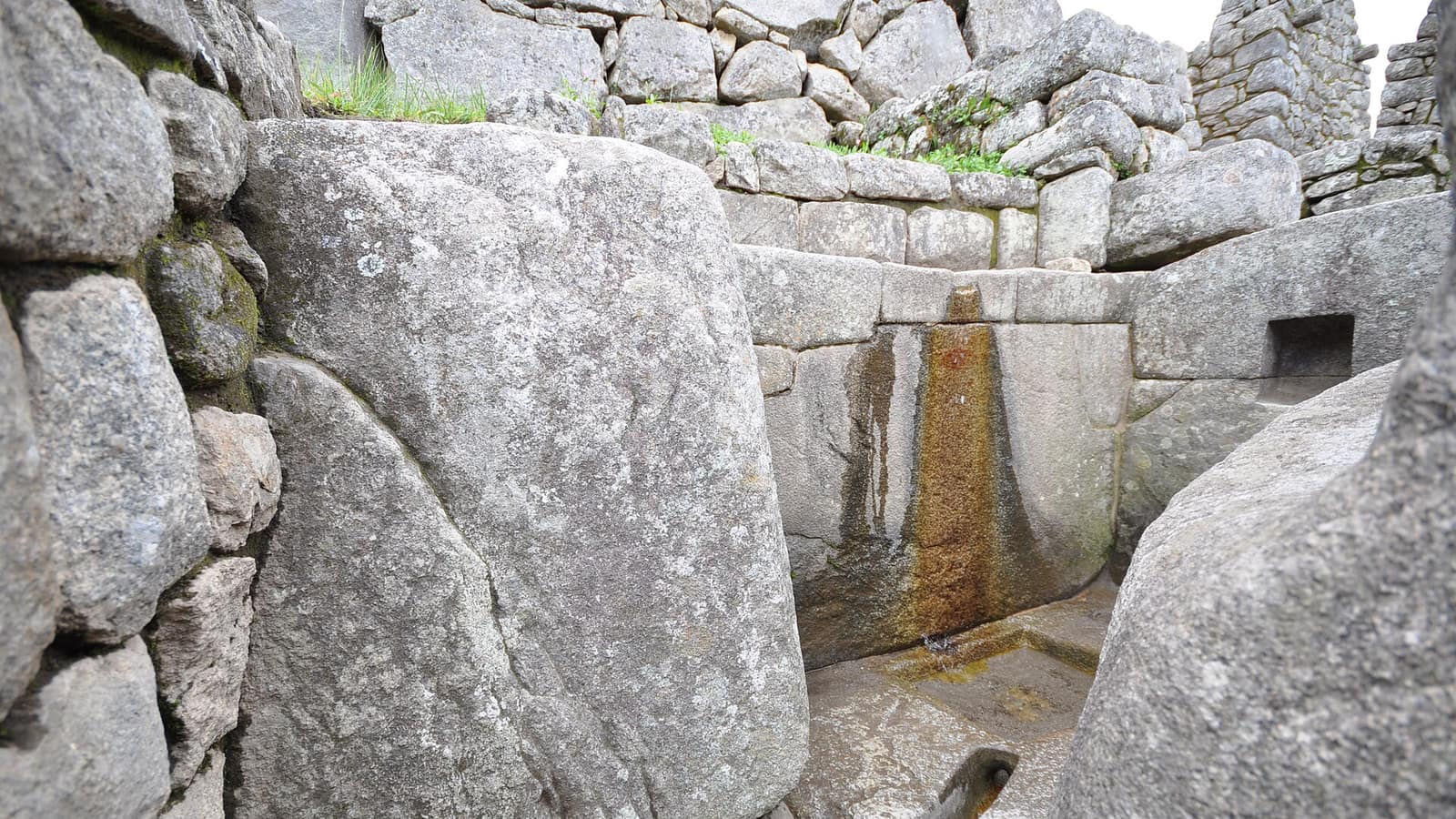
Sixteen stone basins fed by a single spring through a canal cut across the mountainside, dropping through the site in order of precedence, and still running.
- Fountains
- 16
- Canal
- ≈750 m
- Gradient
- ≈3%
The fountains of Machu Picchu are the most underrated thing on the site. Sixteen cut-stone basins run down through the settlement in sequence, fed by a single spring on the mountainside above, carried to them by a canal about 750 m long at a gradient of roughly three per cent: shallow enough not to erode, steep enough to keep moving.
They still work. In the wet season water arrives at the first fountain and drops through the upper part of the sequence, which makes this one of the very few pieces of pre-Columbian engineering a visitor can watch doing its job.
How the system works
The spring was the reason the site is where it is. Inka planners located the water first, then built to it: the canal was cut across the slope, and the settlement was laid out so that the water entered at the top of the ceremonial sector and descended from there.
Each fountain is a walled basin with a carved rectangular spout. The jet is shaped to fall clear of the stone into the basin below, and sized so that a jar can be filled under it without splashing. Overflow passes to the next fountain down.
The order matters. Fountain one sits beside the structure known as the Temple of the Sun, next to the residence usually attributed to the ruler; the sequence descends towards the residential and agricultural sectors. Where a building sat in the water chain reflects where its occupants sat in the hierarchy.
The spring, and how much water it gives
The source is on the northern flank of Machu Picchu mountain, above and behind the site, where a fault line brings water out along a permanent seep rather than at a single mouth. The Inka built a collection wall along it to gather the flow into one channel before the canal starts, which is the part of the system that is least visible and does the most work.
Flow varies through the year by roughly an order of magnitude, and the sequence was built for the low figure rather than the high one. That is the reason for sixteen small basins instead of a reservoir: a modest continuous supply, delivered to sixteen points in a fixed order, serves a settlement of a few hundred people without ever needing to store anything. In the driest months the lower fountains run dry while the upper ones keep going, which is not a fault in the system but the priority order working as designed.
Water as ceremony, not only plumbing
Reading the sequence purely as a water supply misses half of what it was for. Water arriving from a mountain was itself the point: springs and the peaks they came from were treated as beings owed respect, and a channel that brought a mountain’s water into a settlement was doing ritual work as well as domestic work.
That is why the fountain beside the Temple of the Sun is the one built with the most care, and why the sequence descends in status order rather than by the shortest route. The same logic runs through Inka sites generally: cut channels, carved basins and worked outcrops at Tipón, Ollantaytambo and the Coricancha all treat moving water as something to be displayed rather than merely delivered.
The half you cannot see
The visible fountains are the smaller achievement. Machu Picchu is built on a steep ridge in a place that receives around two metres of rain a year, and the ground beneath it is engineered throughout: crushed-stone drainage layers under the terraces, channelled surface run-off, and drains cut through the walls.
Estimates from the surveys of the 1990s put roughly half the total construction effort below ground. The terraces are not principally agricultural. They are the retaining and drainage system that stops the site from sliding off the ridge.
What the surveys actually established
Most of what is known in detail about this system comes from engineering survey work in the 1990s rather than from archaeology in the usual sense: the canal was walked and measured, gradients were recorded, the drainage layers were excavated in section, and the whole thing was assessed as a piece of hydraulic design rather than as a ruin. That is worth knowing because it changed the reading of the site. Machu Picchu had been interpreted as a place chosen for its position and its defensibility, and the water evidence puts a mundane constraint first: the spring is adequate for a settlement of this size and no larger, and the site was laid out around what it could deliver.
Seeing them
The upper fountains are on the main visitor circuit. The lower ones sit on routes that not every current ticket circuit includes, and the circuit system changes, so check what your ticket actually covers before assuming access.
The stonework itself is covered under Inca architecture, the road that served the site under the Inca Trail, and the wider region in the Peru section.
Frequently Asked Questions
How many fountains are there at Machu Picchu?
Sixteen, arranged in a descending sequence from the upper part of the site to the lower. They are usually numbered from the top, and the first sits beside the building conventionally called the Temple of the Sun.
Where does the water come from?
A spring on the north slope of Machu Picchu mountain, above the site. A stone-lined canal roughly 750 m long carries it to the first fountain at a gradient of about three per cent.
Do they still work?
The upper fountains still run in the wet season. The canal has been cleared and partly restored, and water reaching the first basin is one of the few working pieces of pre-Columbian infrastructure a visitor can see operating.
Why is the order significant?
Water reached the highest-status buildings first. The sequence descends from the ceremonial sector towards the residential one, so position in the chain reflects position in the hierarchy.
How were the spouts cut?
Each basin has a rectangular spout cut to throw a controlled jet into the basin below, narrow enough to fill a jar held under it. The dimensions are consistent across the sequence, which suggests a standard rather than an improvisation.
Was drainage part of the same system?
Yes, and it is the larger achievement. Machu Picchu sits on a steep, wet ridge, and about 60 per cent of the construction effort went underground, on Wright's estimate, into drainage layers and channels that keep the terraces from sliding.
Where do you see them on a visit?
The upper fountains are on the standard circuit near the Temple of the Sun. The lower ones require a route that not all current ticket circuits include, so check which circuit your ticket covers.
Who studied them?
The fullest survey was by Kenneth Wright and colleagues in the 1990s, who mapped the canal, measured the gradients and worked out the system's capacity.