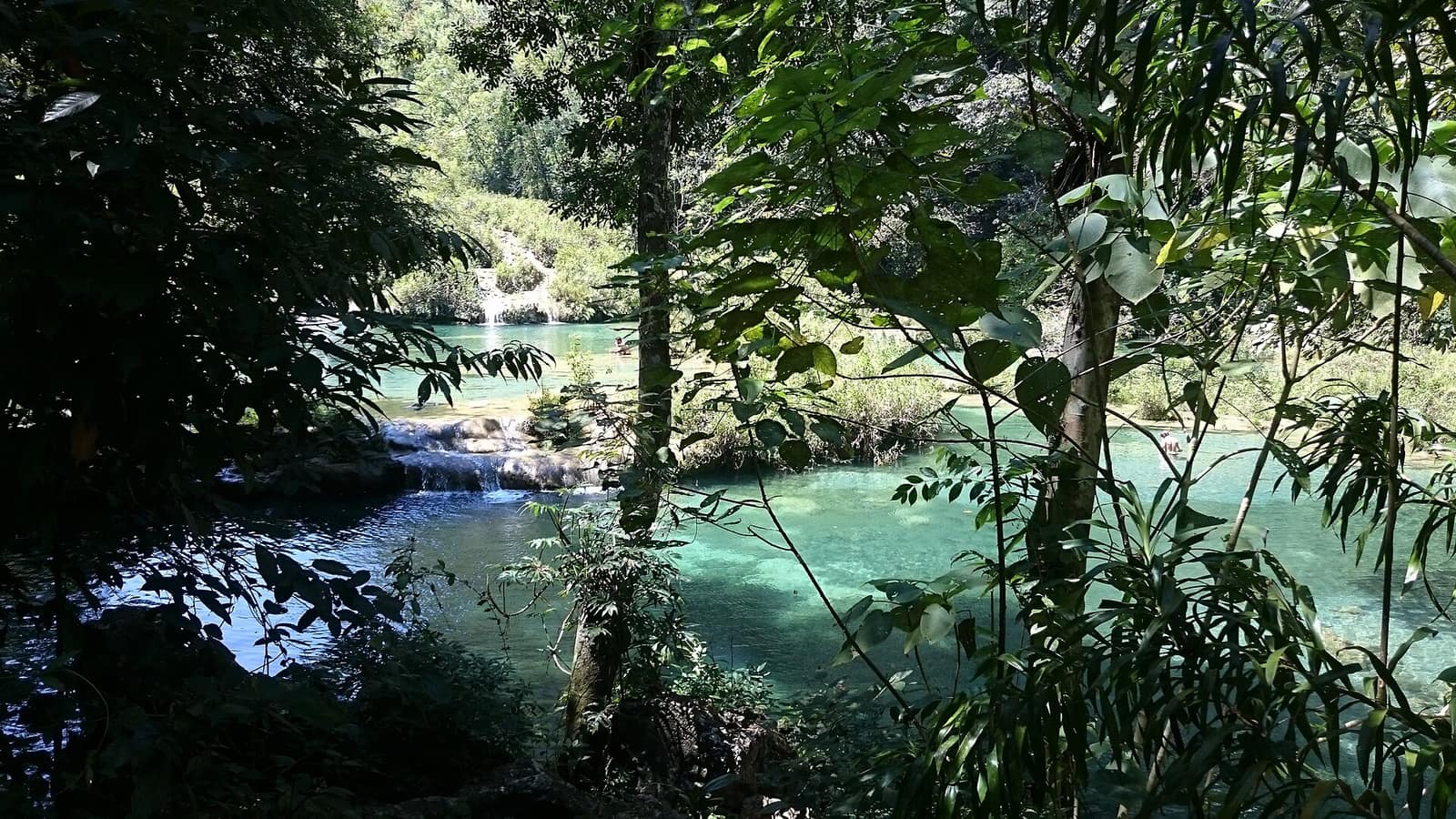

Alta Verapaz, Guatemala
Semuc Champey, Guatemala: the Pools, the K'anba Caves and Lanquín
A 300-metre limestone bridge carrying a staircase of pools, with the Cahabón running underneath it through the rock. The K'anba caves are the same karst and the same day.
- Bridge
- ≈300 m
- Nearest town
- Lanquín
- Approach
- unpaved
Semuc Champey — Guatemala’s most photographed piece of karst — is a natural limestone bridge about 300 metres long, carrying a staircase of shallow turquoise pools, in a forested valley in Alta Verapaz. What makes it unusual is not the colour but the plumbing: the Río Cahabón vanishes into a sinkhole at the upstream end of the bridge, runs underneath it through the rock, and reappears below. The pools on top are fed by springs and rain, which is why they stay calm and clear while a river passes beneath them.
The name is Q’eqchi’ and is usually translated as “where the river hides under the earth”, which is the most accurate description anyone has managed.
The pools: what a day at Semuc Champey in Guatemala looks like
The pools step down the length of the bridge, shallow enough to stand in, connected by short falls you can slide down. They are cold, they are limestone-clear in the dry months, and the rock underfoot is sharp, and the single most common mistake is arriving with no shoes you are willing to swim in.
The order that works: climb to the mirador first, while it is cool and before the middle of the day, then come down and swim. The viewpoint is a steep half-hour on steps, roots and the occasional handrail, and it is the angle every photograph of the place uses. Doing it after two hours in the pools is a different and worse experience.
Almost every one of the Semuc Champey photos you have seen was taken from that platform, which is worth knowing before you decide to skip the climb.
At the downstream end the Cahabón comes back out of the rock at full volume. Standing where the quiet pools end and that starts is the clearest illustration of what the bridge is.
The K’anba caves, and the rest of the karst
Semuc Champey caves are part of the same limestone system and are usually visited on the same day. The K’anba caves, a few minutes from the entrance, are entered with a candle: you wade, you swim short sections in the dark, you climb a couple of ladders with water running down them. Guides run these in small groups and the trip lasts about an hour.
It is not a walk-through show cave. People uncomfortable in dark water should skip it without embarrassment, and nobody should do it alone. For everybody else, the Semuc Champey caves are the part of the day that gets described first afterwards.
The wider valley is riddled with the same karst. The Lanquín caves at the edge of town are a separate visit, worth timing for the evening bat flight.
Getting there from Lanquín, and where to sleep
Lanquín is the base. From the town it is roughly 11 km to the site on an unpaved road that takes about 45 minutes in the back of a pickup, which is how nearly everyone travels it. The road is rough in the dry season and worse in the wet, and there is no version of this journey that is comfortable.
Getting to Lanquín itself: about two and a half hours from Cobán, and a long day from anywhere else. The Semuc Champey to Antigua connection is eight to ten hours by tourist shuttle, usually starting before dawn; the same is broadly true for Guatemala City and for Lake Atitlán. This is the reason Semuc Champey — Guatemala’s most awkwardly placed attraction — gets skipped by short itineraries and the reason people who do go tend to stay two nights.
Accommodation is either in Lanquín town, with the transport, or in the hostels strung along the road nearer the site, which are quieter and shorten the morning ride. Both are simple; the valley has nothing resembling a resort.
When to go, and what the water will look like
November to April is the dry season and the reliable window for clear pools. In the wet months the pools still work, but heavy rain upstream can cloud them for a day or two, and the road in degrades faster than the water does.
Early is better than late in any season. The site opens in the morning, the tour shuttles from Lanquín arrive in a block mid-morning, and the difference between 8am and midday at the mirador is the difference between a platform to yourself and a queue for the railing.
The rest of the region, the caving country of the Verapaces and the highland towns west of it, is covered in the Guatemala section.
Frequently Asked Questions
What exactly is Semuc Champey?
A natural limestone bridge about 300 m long with a staircase of shallow pools on top of it. The Río Cahabón does not flow through the pools. It disappears into a sinkhole at the upstream end, runs under the bridge through the rock, and comes back out below. The pools are fed separately by springs and rainwater, which is why they are calm and clear while the river underneath is not.
How do you get to Semuc Champey?
Via Lanquín, in Alta Verapaz. From Lanquín it is about 11 km of rough unpaved road, usually done standing in the back of a pickup, and it takes around 45 minutes each way. There is no smooth way in, and the road is worse after rain.
How long is Semuc Champey to Antigua?
A long day. The Semuc Champey to Antigua shuttle run is typically eight to ten hours with a change, and most people break it in Cobán or ride the direct tourist shuttle that leaves early morning. Guatemala City is a comparable distance.
Are the pools always turquoise?
No. They are at their clearest in the dry season, roughly November to April. Heavy rain upstream can turn the water cloudy or brown for a day or two, and the Cahabón below runs high and muddy far more often than the pools do.
Should you go up to the mirador?
Yes. The viewpoint above the pools is a steep 30 to 45-minute climb on steps and roots, and it is where nearly all Semuc Champey photos are taken from. Doing the climb first and swimming afterwards is the sensible order.
What are the K'anba caves like?
A wet river cave entered with a candle in one hand, involving wading, short swims and a few ladders. It is genuinely dark and genuinely wet, it is not suitable for people uncomfortable in water, and it is the part of the day most visitors remember.
Can you visit without a tour?
Yes. Transport from Lanquín, the park entrance fee and the mirador are all arrangeable independently. The caves are the exception: those are guided, and correctly so.
How long do you need there?
A full day at the site covers the mirador, the pools and the caves without rushing. Most people stay two nights near Lanquín to make that one day possible without spending it in a pickup.
Where do you stay?
Either in Lanquín town, which has the transport connections, or in the hostels along the road closer to the site, which are quieter and mean a shorter ride in the morning. The valley has no large hotels.
Is there anything else nearby?
Tubing on the Cahabón below the bridge, and the Lanquín caves, a bat cave at the edge of town where the evening exodus is worth timing your arrival for.
Is it crowded?
Busy at midday in high season, and quiet before 10am. The pools spread visitors out more than the photographs suggest, but the mirador platform does not.
What should you bring?
Shoes you can swim in, because the limestone is sharp and slippery in equal measure, plus a dry bag. Everything you carry into the caves will get wet.