_-_10.jpg)
Quiché, Guatemala
Chichicastenango Market: Thursday and Sunday in the Quiché Highlands
Twice a week the K'iche' town fills its plaza and the steps of Santo Tomás, and most of what changes hands is still for the towns around it rather than for visitors.
- Days
- Thu · Sun
- Elevation
- 1,965 m
- Church
- Santo Tomás
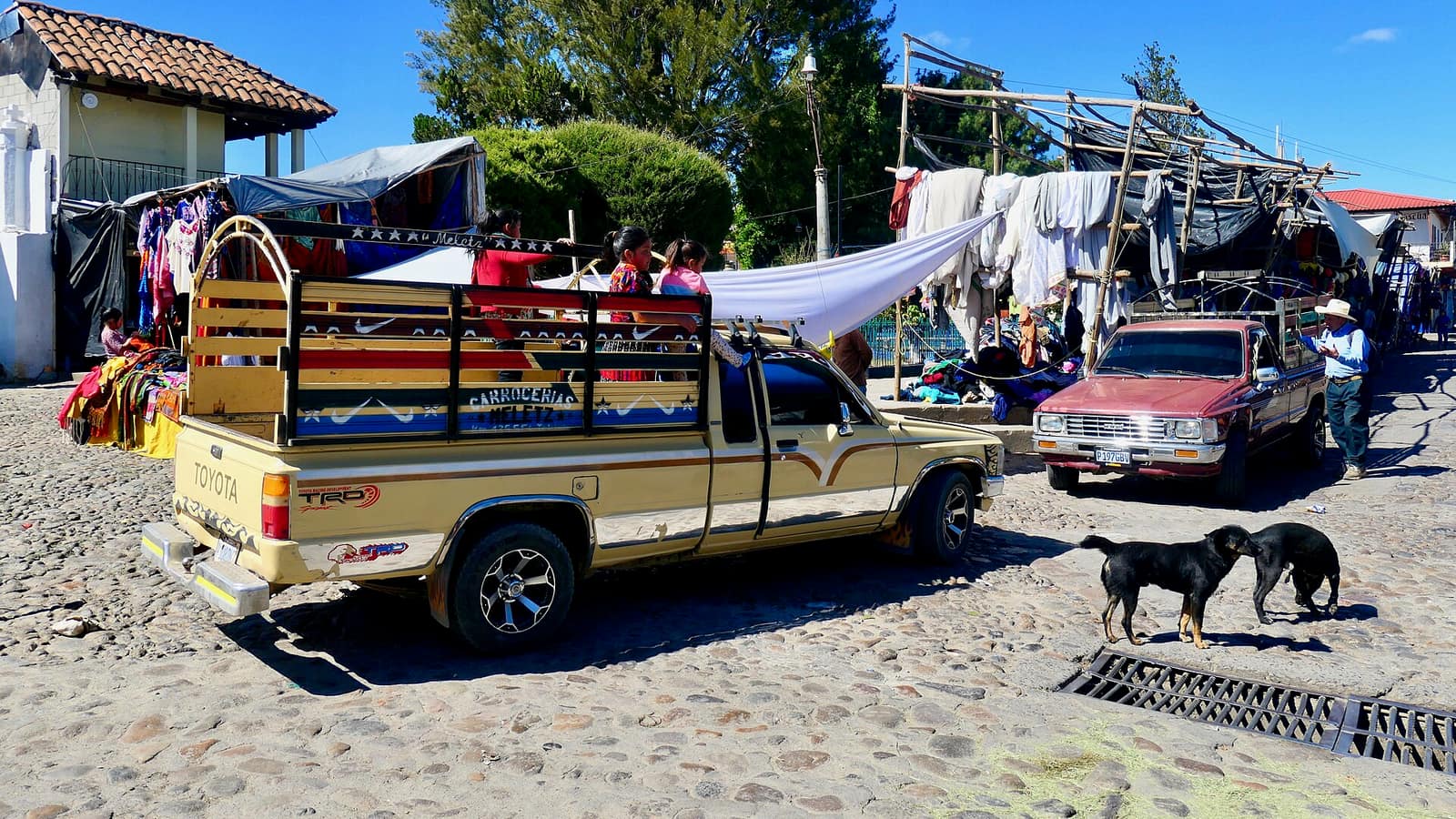
Chichicastenango market takes over the town twice a week, on Thursday and on Sunday, and it is the largest market in the Guatemalan highlands. It has a reputation as a tourist market, which is half right: the front two rows of stalls sell textiles and masks to visitors, and everything behind them sells vegetables, machetes, chicks, candles and plastic buckets to the villages around Chichicastenango, which is why the market exists at all.
The town sits at about 1,965 m in the department of Quiché and is K’iche’-speaking. On market mornings the population multiplies, and the streets around the plaza become impassable to vehicles by seven.
What is actually traded
The market splits into zones without anybody planning it. Textiles and craft around the plaza; produce north and east of it; livestock and tools further out; flowers on the steps and in front of the church, because they are bought for graves and for the altars inside.
That geography is the practical reason to walk further than the first block. The produce section is where prices are argued over in K’iche’ rather than in Spanish, and it is the part of the Chichicastenango market that would still be here if no visitor ever came.
Santo Tomás, and what happens on the steps
The church of Santo Tomás stands at the top of a broad flight of steps at the eastern end of the plaza. Copal resin is burned on those steps, and the smoke is constant through the morning. Inside, a Catholic mass proceeds while, along the nave floor, candles are lit and offerings laid out in a distinct order.
This coexistence is the town’s best-known feature and the one most often photographed badly. The steps are working space for the cofradías, the lay brotherhoods that carry the saints, and the usual courtesy applies: watch, do not climb through, and ask before pointing a camera at anyone.
Buying textiles without guessing
The front rows are where the prices are highest and the provenance is thinnest. Much of what is sold there is resold: brought in from other towns, or made for sale rather than for wear. None of that is dishonest, and a resold huipil is not a worse object than a locally woven one. It only means the price should reflect what nobody in the transaction knows about the piece.
Three questions sort most of it out. Which town is this from? Is the pattern brocade or embroidery? Was it worn? A weaver selling her own work answers all three immediately and will usually say which of her neighbours made the corte. A stallholder who cannot answer any of them is reselling, which is worth knowing before agreeing a figure.
Bargaining is expected and is not adversarial. The first price is an opening position, the second is usually close to the real one, and walking away over the last few quetzales in a market where the maker is standing in front of you is a poor use of the morning. The huipil and highland dress page covers what the cloth is actually saying.
Pascual Abaj, the museum and the cemetery
Three things in Chichicastenango sit outside the market and are open on any day. Pascual Abaj is a blackened stone shrine on a hill south of the town, reached by a marked path through a house yard, where offerings of copal, flowers, alcohol and sometimes chickens are made. It is in use, not preserved, and the same courtesy applies as on the church steps.
The Museo Regional Rossbach, on the plaza, holds a collection of jade, obsidian and ceramics assembled by a parish priest who spent decades in the town. It takes twenty minutes and puts the market’s older trade in some context.
The cemetery, on the western edge of town, is a hillside of painted tombs in flat colour, laid out in blocks and tended visibly. It is the clearest single illustration of how the two religious systems in this town run alongside each other rather than one having replaced the other.
Getting there, and when
Three hours from Antigua, ninety minutes from Lake Atitlán. Tourist shuttles run on market days and leave early; buses run daily and take longer. Staying the night before is the only reliable way to be in the market before the shuttles unload, and it is worth doing once.
Thursday is smaller and easier. Sunday is bigger, busier and the day the religious calendar is most visible. Neither is wrong; they are different mornings.
Stalls are built the evening before, so a Wednesday or Saturday afternoon arrival shows the town being assembled and gets you a room at a normal price. Bring small notes: the tourist rows take cards and nothing else does, and the town’s cash machines are unreliable on market mornings for the obvious reason. In the wet season the rain arrives in the afternoon rather than the morning, which matters less here than elsewhere because the market thins out by two in any season.
Both connect naturally with Antigua and the rest of the Guatemala highland circuit, and the market is almost never the only reason somebody is in this part of the country, and it should not be.
Frequently Asked Questions
Which days does the Chichicastenango market run?
Thursday and Sunday. Sunday is the larger of the two and also the day the cofradías are most active around the church, which is why most visitors are told to come then and why Thursday is often the better experience.
What time should you arrive?
Before nine if you want the market at work rather than the market at trade. Sellers set up from dawn, the tour buses arrive between ten and eleven, and the middle of the day is when the textile stalls are busiest.
Is it a tourist market?
Partly. The textile and mask stalls near the plaza are aimed at visitors; the produce, tools, plastic goods, livestock and flowers filling the streets behind it are not. Walking two blocks off the square is the whole difference.
What happens on the church steps?
Copal incense is burned on the steps of Santo Tomás as part of Maya observance that runs alongside the Catholic mass inside. It is not a display, and the steps themselves are used by cofradía members rather than by the general congregation.
Can you photograph people?
Ask first, and expect to be refused sometimes. Photographing ceremonies on the church steps without permission is the thing most likely to cause genuine offence.
How do you get to Chichicastenango?
About three hours from Antigua and ninety minutes from Panajachel on Lake Atitlán by tourist shuttle, both leaving very early on market days. Chicken buses run the same route more slowly and more often.
Should you stay overnight?
It solves the arrival problem: staying Wednesday or Saturday night gets you into the market before the shuttles. The town is quiet on non-market days and there is not much else to do in it.
What is worth buying?
Textiles, if you know what you are looking at. The market draws weaving from across the department, and quality and price both vary wildly across fifty metres. Masks are mostly made for sale rather than for dance.
Is haggling expected?
Yes, within reason. Opening prices to visitors carry a wide margin; a first counter at around two-thirds is normal and grinding much below that is not.
Is the cemetery worth visiting?
The painted tombs on the hillside above town are one of the more striking sights in the highlands, and quiet compared to the plaza. Go in daylight and in company.