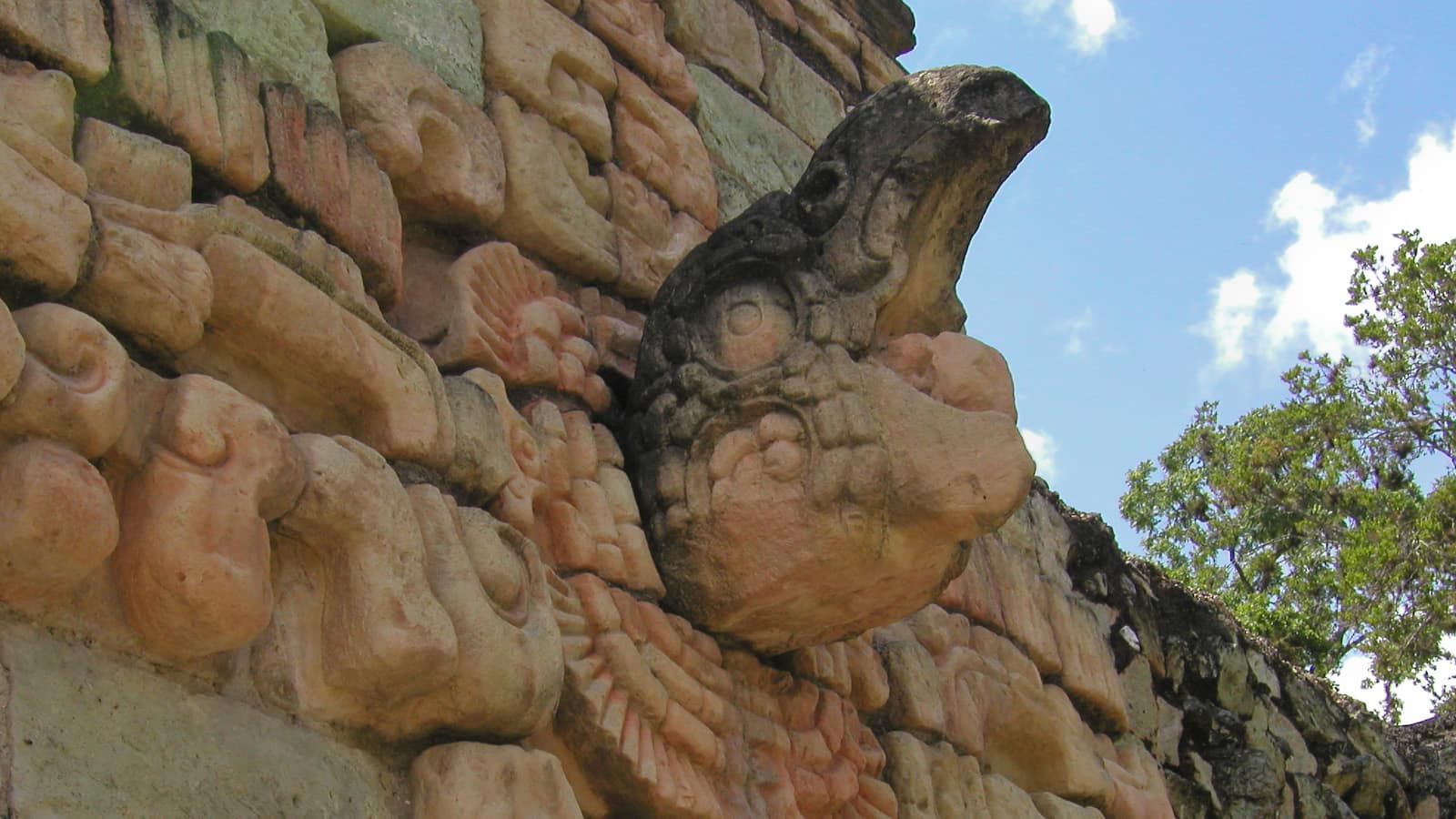

Copán, Honduras
Copán, Honduras: the Finest Maya Carving and the Hieroglyphic Stairway
Small, dense and carved more finely than any other Maya site, the result of a soft volcanic tuff that took three-dimensional relief where limestone could not.
- Stairway
- ≈2,200 glyphs
- Visit
- half day
- From Guatemala
- border at El Florido
Copán Honduras is the Maya site people go to for the carving. It sits in a river valley in western Honduras, twelve kilometres from the Guatemalan border, and it is small: the ceremonial core can be walked in an hour. What it holds is the finest sculpture in the Maya world.
The reason is geological. Copán’s sculptors worked a soft volcanic tuff instead of the limestone used across the Petén, and tuff takes undercutting. The stelae here are carved almost in the round, with figures standing free of the block, which is why they look like statues where elsewhere they look like reliefs.
The hieroglyphic stairway
The site’s centrepiece is a stairway of 62 steps carrying roughly 2,200 individual glyph blocks, the longest Maya text known anywhere. It records the dynastic history of the city’s rulers.
It also cannot be fully read. The stairway was reassembled in the early twentieth century before Maya writing could be deciphered, and most of the blocks went back in the wrong order. What remains is a text whose vocabulary is legible and whose sentences are shuffled, a problem epigraphers have been working on ever since.
What else is there
- The Great Plaza and its standing stelae, most raised under the ruler known as 18-Rabbit.
- The acropolis, built up in layers over four centuries, with excavation tunnels running through the earlier structures beneath it.
- The sculpture museum, which holds the originals of the most important pieces and a full-scale, full-colour reconstruction of the Rosalila temple found buried intact inside a later pyramid, the single best illustration anywhere of what these buildings actually looked like.
- Las Sepulturas, a residential complex a short walk away, quiet and usually empty.
The dynasty the carving records
Copán’s inscriptions are unusually complete as dynastic records go, and they name a line of sixteen rulers running from the founder, K’inich Yax K’uk’ Mo’, early in the fifth century to the last recorded accession late in the ninth. That is the text the stairway carries and the reason epigraphers care about a site that is otherwise modest in scale.
Two rulers account for most of what a visitor sees. The thirteenth, Waxaklajuun Ub’aah K’awiil, usually called 18-Rabbit, raised most of the free-standing stelae in the Great Plaza and was captured and killed by the neighbouring city of Quiriguá in 738, an event the monuments at both sites record from opposite directions. The fifteenth, K’ahk’ Yipyaj Chan K’awiil, rebuilt the stairway that carries the history.
Tunnels, and the buildings inside buildings
The acropolis was rebuilt repeatedly, each version raised over the last, and archaeologists drove tunnels into it rather than dismantling the outer shell. Those tunnels found the Rosalila temple intact with its painted stucco still on it, which is what the museum reconstruction is based on, and a series of earlier tombs beneath it.
A short section of the tunnels is open to visitors for a separate and considerably higher fee. It is a narrow, humid, twenty-minute walk past exposed façades of buried structures. Whether it is worth the price is genuinely arguable; the museum reconstruction shows more for less.
What the tickets cover
Copán is ticketed in parts rather than as one site, which matters if you arrive with a fixed budget. For visitors from outside Central America the archaeological park and Las Sepulturas share one ticket at US$20; the excavation tunnels are a separate US$15; the sculpture museum, which holds the Rosalila reconstruction, is US$10; and the regional archaeology museum in the town is US$5. Central American visitors pay half for the park and half for the sculpture museum, and Honduran nationals pay in lempiras at a much lower rate. The tariff is set by the Honduran Institute of Anthropology and History, which administers the site.
The pricing is what makes the tunnel question sharp. Twenty minutes underground costs three quarters of the entire archaeological park, and it costs half again what the sculpture museum does. Anyone choosing between the two extras should take the museum, because the Rosalila reconstruction is the one thing at Copán that exists nowhere else.
The valley was inscribed on the UNESCO World Heritage list in 1980, and the inscribed property covers the river and its tributaries as well as the ruins themselves.
Getting there and staying
Copán Ruinas, the town, is a kilometre from the site, and is the pleasantest small town in this part of Honduras. Shuttles run from Antigua and Guatemala City in five to six hours, crossing the border at El Florido, and most visitors treat Copán as an extension of a Guatemala trip rather than as a Honduran destination.
Two nights is right: a half day at the site, an hour in the museum, and an afternoon left over.
For how Copán compares with the other sites in the region, see Mayan ruins; the rest of the surrounding countries are in the Elsewhere section.
Frequently Asked Questions
How do you get to Copán from Guatemala?
Shuttles run from Antigua and from Guatemala City to Copán Ruinas town, crossing at El Florido, and take five to six hours. The town is a kilometre from the site and most visitors stay there rather than day-tripping.
How long do you need?
Half a day at the site, plus an hour for the sculpture museum, which holds the originals of the stelae now weathering outside. Two nights in the town covers it comfortably.
What is the hieroglyphic stairway?
A stairway of 62 steps carrying around 2,200 glyph blocks, the longest Maya inscription known. It was reassembled early in the twentieth century largely out of order, which means much of it cannot be read as a continuous text.
Why is the carving better here?
Material. Copán's sculptors worked a fine volcanic tuff rather than the harder limestone of the Petén, and it takes undercutting and deep relief that limestone will not.
Are the stelae originals?
The ones in the Great Plaza are originals and are weathering. The sculpture museum holds the most important pieces under cover, along with a full-colour reconstruction of the Rosalila temple, which was buried intact under a later structure.
Is there wildlife at the site?
Scarlet macaws, reintroduced and now resident, are all over the entrance area. They are genuinely wild-flying and genuinely loud.
Do you need a guide?
More than at any other Maya site. The carving carries dynastic history in detail, and without somebody to read it the visit becomes a walk among decorated stones.
Is the tunnel visit worth it?
The excavation tunnels under the acropolis cost extra and are short. They are worth it if you are already interested in how the site was built up in layers, and skippable otherwise.