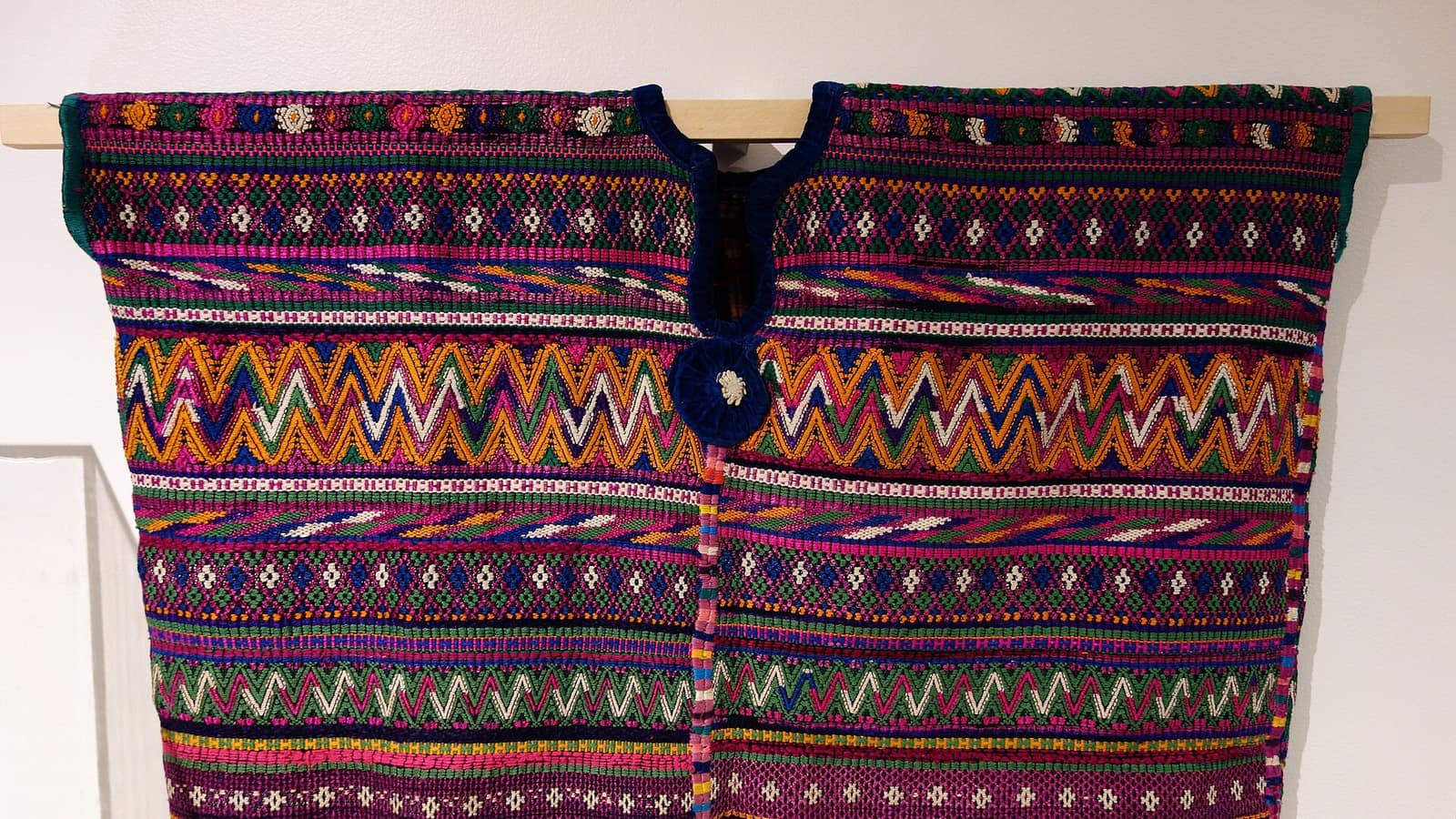

Western Highlands, Guatemala
The Maya Huipil and Corte: What Highland Women and Men Actually Wear
Traditional dress is still worn daily in the Guatemalan highlands, and it is village-specific: the huipil of Nebaj is not the huipil of Todos Santos. Twenty-two Mayan languages, dozens of towns, and a cloth that says which one before anyone speaks.
- Loom
- backstrap
- Mayan languages
- 22
- Worn
- daily
A huipil is the blouse a Maya woman wears — not the long huipil dress sold abroad — and in Guatemala it is still worn daily rather than kept for festivals. It is also the single most legible thing in the highlands: the huipil worn in Nebaj does not look like the one worn a valley away in Todos Santos, and the difference is not decoration but identification. The cloth says where its wearer is from, and this page is about the garment that is worn rather than the one that is exported.
Two answers to what is a huipil are useful. The plain one: a blouse of one to three woven panels, joined at the selvedges, with holes left for the head and arms. The longer one is the subject of this page, because a garment that is never cut to shape has to carry all of its design in bands, and those bands are where the information sits.
What a huipil is, and how to read one
The panels come off the loom at a fixed width and are joined side by side, so the decoration runs horizontally across the chest and shoulders. Where a town’s weavers put the densest band, whether at the neck, across the yoke or low on the body, is one of the first things that separates one place from another.
Neckline treatment is the second. A round neck bound in silk, a square neck with a woven collar, a slit finished with a rosette: these are stable enough within a town to work as markers. Motifs are the third, and the least reliable on their own, because they travel. Double-headed birds, diamond figures standing for the four directions and the sun’s path, zigzags for lightning and for the mountains behind the town: the vocabulary is shared, the arrangement is local.
The corte and the faja: what is worn with the huipil
A huipil is worn with a corte, a length of cloth wrapped as a skirt, and held by a faja, a woven belt several metres long. The three are made differently and often bought separately: the huipil by backstrap weaving at home, and a corte that will frequently come from a workshop in another department entirely.
The corte is the garment most visitors misread, because it is not made the way the huipil is. Cortes are woven on a treadle loom in longer runs — historically by men, in workshops that supply a whole region — and are frequently patterned with jaspe, the tie-dyed warp that gives them their soft-edged bands. A woman may weave her own huipil and buy her corte from two departments away, which is why the two halves of one outfit can look like they come from different traditions.
Backstrap weaving: how the cloth is actually made
Backstrap weaving is the technique behind almost every huipil. The warp is stretched between two bars; one is tied to a post or a tree, the other is held against the weaver’s body by a strap around her back. Tension comes from how she leans. There is no frame, no fixed size and nothing to transport but the sticks and the cloth itself.
That has consequences you can see. The width of a panel is the width a woman can comfortably reach across, which is why huipiles are built from several panels rather than one wide piece. And because the weaver’s body is part of the loom, the work stops and starts around everything else in the day, which is the real reason a densely worked piece takes months.
The figures are laid in as brocade while the ground cloth is being woven: an extra weft thread, counted in by hand against the warp, floating over the surface where the pattern needs it. It is not embroidery, and it cannot be added afterwards.
Village-specific dress, town by town
The village-specific principle is what makes Guatemalan textiles worth looking at closely rather than in bulk. A few towns whose dress is unusually easy to recognise:
- Nebaj, in the Ixil area, where the huipil is dense with small figures and the women wind an elaborate pom-pommed headcloth.
- Todos Santos Cuchumatán, one of the few places where men’s traje survives in full, with red and white striped trousers, a striped jacket, a small straw hat.
- Santa Catarina Palopó on Lake Atitlán, where an almost uniform blue-and-turquoise scheme was adopted comparatively recently and now defines the town at a glance.
- San Antonio Aguas Calientes, near Antigua, known for double-faced brocade, where the pattern reads cleanly on both sides of the cloth.
- Santiago Atitlán, where the men’s short embroidered trousers and the women’s headband, the tocoyal, are distinctive enough to have ended up on the twenty-five-centavo coin.
- Chichicastenango, whose ceremonial huipiles carry sun and double-eagle motifs, and whose market is the easiest place to see many towns’ dress in one morning.
- Zacualpa, in Quiché, where the huipil is worked on a red ground in dense geometric brocade — the town the phrase traje de Zacualpa refers to.
- San Juan Atitán, in Huehuetenango, one of the few places where men’s traje survives in daily use: red-striped trousers, a dark wool capixay over them, and a small hat.
- Nahualá, in Sololá, where the wool is heavy and the men’s rodillera is still worn.
- San Juan Sacatepéquez, close to the capital and still weaving a distinct purple-banded huipil despite it.
- Aguacatán, where the women’s headband is wound wide and flat and reads from a distance.
- Sacapulas and San Mateo Ixtatán, at the two ends of Quiché and Huehuetenango, whose huipiles are among the most distinct in the country — Ixtatán’s worked in large radiating stars.
Weakening, but not gone: garments are sold, traded and inherited across town lines, younger weavers borrow motifs they like, and a woman living in the capital may wear the dress of the town her grandmother left. Reading village-specific traje is a skill with error bars, and anyone who tells you it is exact is selling something.
What Mayan traditional clothing is called
Guatemala recognises twenty-two Mayan languages alongside Spanish, Xinka and Garífuna, and the textile map follows the language map more closely than it follows the departmental one. K’iche’, Kaqchikel, Mam, Q’eqchi’, Tz’utujil and Ixil areas each have their own regional character before you get down to individual towns.
That is also why the phrase mayan clothing is too coarse to be much use on the ground. Mayan clothing in the Ixil triangle and mayan clothing on the shore of Lake Atitlán share a construction method and very little else. A guatemalan huipil is always a huipil; which guatemalan huipil it is takes a town, not a country.
Guatemalan traditional clothing for men
Men’s traje has receded much further than women’s, and where it survives it is usually a marker of office rather than of daily habit: the cofradía elders of a town will wear it when the women of the same town wear theirs every day. Four places keep it in ordinary use. Todos Santos Cuchumatán is the best known — red and white striped trousers, a striped jacket with a heavily worked collar, and a small straw hat — and San Juan Atitán keeps the same trousers under a dark wool capixay. Sololá and Nahualá keep the rodillera, a woollen wrap worn over the trousers from the waist to the knee, which is the garment most often mistaken for a skirt by visitors. Santiago Atitlán’s men wear short embroidered trousers with the bird and flower motifs the town uses on everything else.
Where men’s dress has gone, it has usually gone to work: a wool capixay is hot, a hand-woven shirt is expensive to replace, and neither survives a construction site or a bus route. That is worth knowing before reading its absence as a loss of identity — in most of these towns the women’s traje is doing the identifying for the household.
Where to see huipiles being woven and worn
Markets are the honest place to start. Chichicastenango on Thursday and Sunday brings in sellers and buyers from across the department, and much of what changes hands there is for local use rather than for visitors. The lakeside towns around Lake Atitlán are the best place to watch backstrap weaving being done, because several cooperatives there work in the open and will demonstrate the loom before they sell you anything.
Antigua has the widest selection and the highest prices, and the least connection between the cloth and the place it came from. It is a reasonable place to buy and a poor place to learn.
If you want to buy well: ask which town a piece is from, ask whether it is brocade or embroidery, and ask whether it was worn. A weaver will answer all three without hesitation. A reseller who cannot answer any of them is not necessarily cheating you, but the price should reflect what nobody knows about the garment.
Frequently Asked Questions
What is a huipil?
What is a huipil, in one sentence: it is the woven blouse worn by Maya women in Guatemala and southern Mexico. It is built from one, two or three rectangular panels of cloth joined along their selvedges, with openings left for the head and arms. The garment is not cut to shape, which is why the decoration sits in bands that run the full width of the panel.
What is the difference between a huipil and a corte?
The huipil is the blouse; the corte is the wrap skirt worn with it. They are usually made on different looms: the huipil on a backstrap loom at home, the corte on a treadle loom, historically by men, in workshops that supply a whole region.
Is the pattern on a huipil embroidered?
Usually not. Most of the figures are brocade: a supplementary weft laid in by hand while the cloth is being woven, so the design is part of the fabric rather than added to its surface. Embroidery does appear, most visibly around necklines, but reading brocade as embroidery is the most common mistake visitors make about Guatemalan textiles.
How long does a huipil take to weave?
A plain one can be finished in a couple of weeks of part-time work. A densely brocaded ceremonial huipil is a matter of months, which is the honest explanation for prices that look high next to machine-made cloth in the same market.
Can you really tell which village a woman is from by her huipil?
Often, though less reliably than fifty years ago. Colour, the arrangement of bands, the neckline and specific motifs still identify many towns clearly. Migration, sold and traded garments, and younger weavers borrowing motifs across town lines all blur the picture.
Do men wear traje as well?
In a minority of towns, yes. Todos Santos Cuchumatán and Sololá are the best-known cases, with red-striped trousers in the first and wool over-garments in the second. Across most of Guatemala men shifted to non-indigenous clothing generations earlier than women did.
Is it disrespectful for a visitor to wear a huipil?
Buying and wearing one is not generally treated as an offence, and weavers sell to visitors deliberately. What does cause offence is wearing a ceremonial piece as a costume, or photographing people in their own dress without asking first.
Where can you buy a huipil directly from the weaver?
Weaving cooperatives in and around Lake Atitlán, Quetzaltenango and San Antonio Aguas Calientes sell directly, and many will show you the loom the cloth came off. Market stalls in Chichicastenango and Antigua more often resell, which is not a problem in itself as long as the price reflects it.
What are Guatemalan textiles made from?
Mostly cotton, including the naturally brown ixcaco cotton grown on the Pacific slope, with wool in the coldest highland towns and silk historically reserved for ceremonial neckline embroidery. Aniline dyes have largely replaced cochineal and indigo, though natural-dye projects have brought both back in some cooperatives.
What is jaspe?
Jaspe is the local name for ikat: threads are tied and dyed in sections before weaving, so the pattern emerges blurred at the edges as the cloth comes together. It is used most on cortes, and the soft-edged bands it produces are one of the easiest things to recognise in Guatemalan textiles.
Is a huipil dress the same thing as a huipil?
No. A huipil dress is a longer garment sold mainly outside Guatemala, sometimes cut down from an older huipil. The traditional pairing is a huipil with a corte and a faja, not a single full-length piece, so a huipil dress is a garment the highlands do not actually wear.
When is the best time to see traje being worn rather than sold?
Market days and religious festivals. Chichicastenango on Thursdays and Sundays, Santiago Atitlán around Semana Santa, and any town's patron-saint fiesta will show far more everyday and ceremonial dress than a craft shop ever will.